MMCH

Declawing/Scruffing
Scruffing and Respectful Cat Handling
For many years, scruffing was commonly recommended as a way to restrain or control cats. Today, we understand much more about feline behavior, stress, and handling. As a result, modern feline care has largely moved away from routine scruffing in favor of gentler, lower-stress handling techniques.
What Is Scruffing?
Scruffing is the act of grabbing a cat by the loose skin on the back of the neck, often to control movement or prevent resistance. Many people were taught that scruffing is harmless because mother cats carry their kittens this way. While that comparison is common, it is often misunderstood. Mother cats carry very young kittens by the scruff for short periods of time during a specific stage of development. Adult cats are much larger, much heavier, and were not designed to be routinely lifted, carried, or controlled by the skin on their neck.
Why Scruffing Is Not Recommended
Lifting or carrying an adult cat by the scruff can cause discomfort, pain, fear, and stress. The skin on the back of a cat's neck was never intended to support the full weight of an adult cat. One reason scruffing became popular is that many cats become still when it happens. However, stillness does not necessarily mean comfort.
What may appear to be a calm response is often a fear or freeze response. A cat that stops struggling is not automatically relaxed or accepting the situation. In many cases, the cat has simply stopped resisting.
Imagine if someone grabbed you by the skin on the back of your neck and used it to control where you could go. Most people would immediately recognize that as uncomfortable, stressful, and potentially painful. Cats deserve the same consideration.
The Impact on Trust
Cats learn through experience. When handling repeatedly causes fear or discomfort, a cat may begin to associate people with stressful experiences. This can make future handling, veterinary visits, nail trims, medication administration, and transportation more difficult. Trust takes time to build, but it can be damaged very quickly.
Our goal should not be to control cats through fear. Our goal should be to help them feel safe enough to trust us.
What Modern Cat Handling Looks Like
Today, many veterinarians, behavior professionals, and feline-friendly handling programs recommend using the least amount of restraint necessary.
Whenever possible:
-
Support the cat's entire body when lifting
-
Allow the cat to maintain a sense of control
-
Move slowly and calmly
-
Use positive reinforcement
-
Reduce fear and stress whenever possible
-
Avoid unnecessary force
Are There Exceptions?
There may be rare emergencies where quickly grabbing or restraining a cat is necessary to prevent serious injury or save a life.
Examples may include:
-
Preventing a cat from running into traffic
-
Pulling a cat away from immediate danger
-
Preventing a dangerous fall
MMCH's Position
We believe cats should be handled with patience, respect, and understanding. Cats are not objects to be controlled. They are living beings capable of fear, stress, comfort, and trust. Whenever possible, cats should be guided and supported rather than restrained through force.
Studies have found that cats displayed more signs of stress and negative responses when scruffed compared to gentle, passive handling. The authors recommended avoiding scruffing whenever possible and using lower-stress handling techniques instead.
Declawing is an Amputation, Not a Nail Trim.
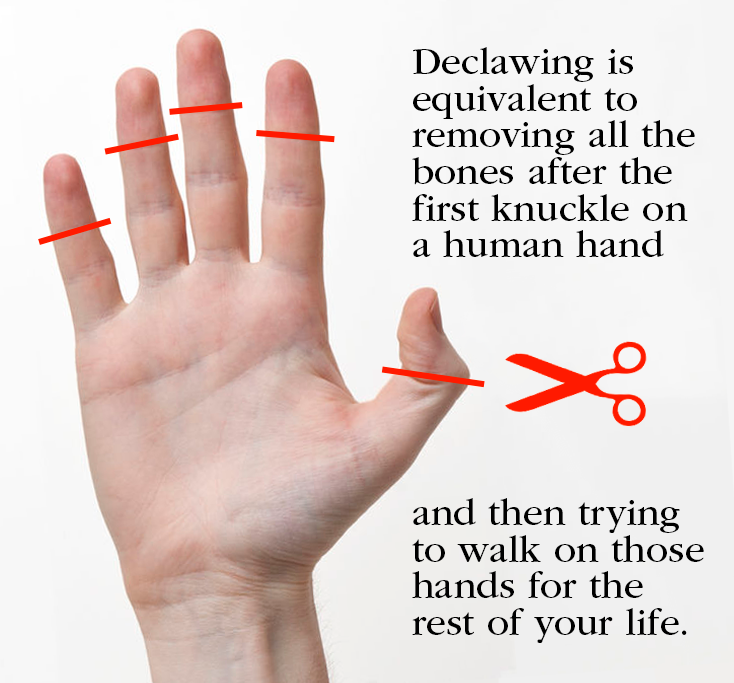
Many people believe declawing is a simple procedure that removes a cat's claws. In reality, declawing is a surgical amputation. A cat's claw is attached to the last bone of each toe. To permanently prevent the claw from growing back, that bone must be removed. In human terms, it would be similar to removing each finger at the last knuckle.
Take a moment to imagine how your own life would change if the tips of all your fingers were surgically removed. How would you grip objects, type on a keyboard, button a shirt, open a jar, or perform everyday tasks? While people and cats use their hands and paws differently, the comparison helps illustrate that declawing is far more than a nail trim, it permanently alters the anatomy of the foot.
Cats rely on their claws for balance, stretching, climbing, self-defense, and normal movement. When those claws and bones are removed, cats can experience both short-term and lifelong physical and behavioral consequences.
Some declawed cats develop chronic pain, arthritis, nerve damage, or changes in the way they walk. Others become more fearful because they no longer have their primary means of defense. This can lead to behavioral problems such as biting, anxiety, or avoiding the litter box due to discomfort when digging in litter.
Declawing does not eliminate a cat's instinct to scratch. Scratching is a healthy and necessary behavior that allows cats to stretch, mark territory, maintain claw health, and relieve stress. Instead of declawing, cat owners can provide scratching posts, scratching pads, regular nail trims, nail caps, and positive reinforcement to redirect scratching behavior.
At MMCH, we believe cats deserve to keep the body parts nature intended them to have. We encourage cat owners to explore humane alternatives to declawing and to understand the lifelong impact this procedure can have on a cat's physical and emotional well-being. A scratched couch can be repaired or replaced. A cat's toes cannot.